How To Get Your Business Mentioned In Google's AI
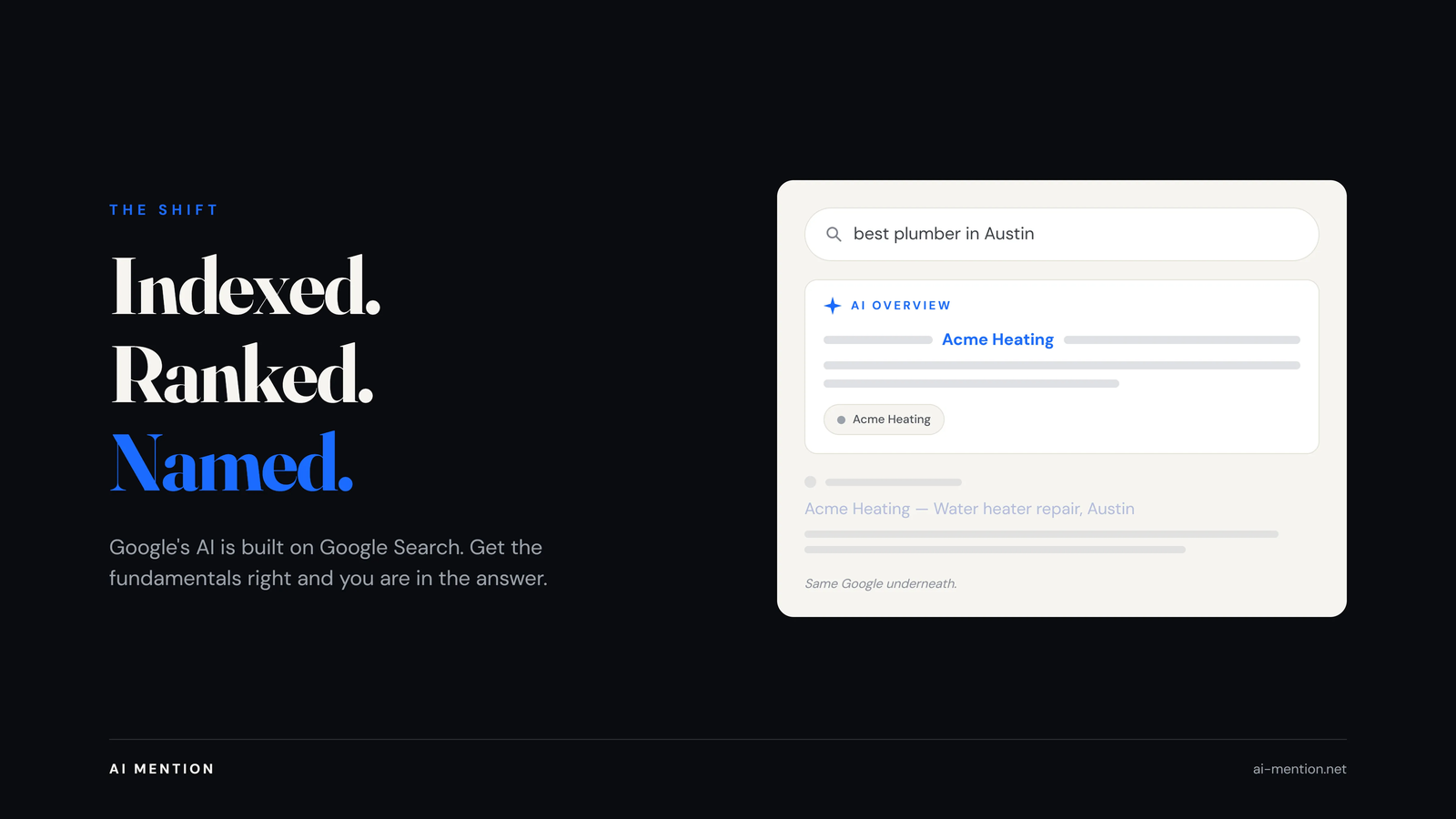
The AI most business owners actually meet is not a separate app they downloaded. It is the AI Overview sitting at the top of a normal Google search, and the Gemini answers behind it. That matters, because Google's AI is not a new world with new rules. It is Google Search with an answer layer on top, and that changes what you have to do to get named in it.
This is the one platform where "AI visibility" and the search work you already half understand are the same job.
Google's AI is Google Search with an answer layer
You do not have to take our word for how Google's AI decides what to say. Google is explicit in its own guidance on AI features in Search: "our generative AI features on Google Search are rooted in our core Search ranking and quality systems."
Read that slowly, because it is the whole game. AI Overviews and Gemini's grounded answers are built from the same index, the same ranking, and the same quality signals that decide an ordinary Google result. There is no separate AI league table you can enter by the side door. The businesses Google's AI names are, overwhelmingly, the businesses Google Search already knows and trusts.
Step zero: be in the pool
Before any of the clever stuff, there is a boring, non-negotiable requirement. Google states it plainly: "To be eligible to be shown in generative AI features on Google Search, a page must be indexed and eligible to be shown in Google Search with a snippet."
So a page that Google cannot crawl, or has not indexed, cannot appear in an AI Overview at all. No prompt trick changes that. And because the AI features are rooted in the core ranking systems, the pages they draw on are the ones those systems already surface. In plain terms: your ordinary Google visibility is your Gemini visibility. If you rank for "water heater repair in Austin," you are in the pool the AI Overview picks from. If you are invisible in normal Google, you are invisible to its AI.
What Google's AI treats as a nameable business
Across our own testing, some signals show up in the AI's reasoning almost every time, and some are far more hit and miss.
- Local relevance is nearly always present. If Google cannot connect you to a specific place, it cannot confidently name you for a place-specific question.
- Authority and credibility are just as reliable.
- Service specificity, how precisely you match the exact thing asked, is consistently one of the strongest signals.
- Reviews and reputation matter, but feature less consistently than owners assume.
- Directory presence is the most variable of all. For some trades it is central; for others it barely registers.
Google has an unfair advantage on the top signals, and it works in your favor if you let it. Local relevance, authority, and reviews are exactly what Google already collects in enormous depth through your Google Business Profile, Maps, and the reviews attached to it. That profile is best understood not as one magic signal but as Google's own source for the signals that do the work. Keep it accurate and complete and you are feeding the machine directly.
Three surfaces, one underlying Google
People tie themselves in knots trying to optimize separately for the AI Overview, the Gemini app, and the local map pack. They are different windows onto the same Google knowledge. A business that Google understands clearly, that ranks, and whose profile is accurate, tends to show up across all three. Chasing them one at a time is effort you do not need to spend.
How to become the business Google's AI names
The honest headline is unglamorous: strong local search fundamentals are Google AI optimization, because the AI is built on them. There is no separate playbook.
- Be indexable, then rank. Make sure your pages can be crawled and are indexed, then do the ordinary work to rank for the specific queries your customers use. That is the eligibility gate and the selection pool in one.
- Feed your Google Business Profile. Complete it, keep the service and area accurate, and keep it current. It is Google's own record of you, and Google's AI leans on it heavily for local answers.
- Write for the specific question. A page that says "we install tankless and standard water heaters across Austin, licensed and insured, same-day service" gives the AI a clean, liftable fact. "Your trusted local experts" gives it nothing.
- Earn reviews that name the job and the city. They feed both the local-relevance and reputation signals, and they live in Google's own ecosystem.
- Keep name, address, and phone identical everywhere. Contradictions dilute the confidence Google needs to name you.
How to test what Google's AI says about you
This one is easy, because you can see it in the results you already use. Run the questions your customers would ask, two ways:
- Do a normal Google search for "best [your trade] in [your city]" and read the AI Overview at the top. Who does it name?
- Ask Gemini the same question directly.
- Try it with and without your location set, and try the specific version: "[specific service] near [your area], who should I use?"
Note whether you are named, linked, or absent, then do the same for the two or three competitors you lose work to.
Do not assume it matches ChatGPT
Here is the trap. In our testing, different AI systems named strikingly different businesses for the exact same question, because they are grounded in different places. Google's AI and ChatGPT do not agree. Being named by ChatGPT tells you very little about whether Google's AI names you, and the reverse is just as true. If Google is where your customers search, test Google. (We wrote the companion piece on getting mentioned on ChatGPT separately for exactly this reason.)
What not to waste time on
Schema markup as the key to AI. Google is blunt in the same guidance: "Structured data isn't required for generative AI search, and there's no special schema.org markup you need to add." Keep a basic Local Business block for normal rich results, then stop expecting it to be your way in.
Directory blasts. Because directory presence is the most volatile signal, paying to be added to hundreds of generic directories no one reads is effort spent on the least dependable lever. A handful that genuinely match your industry beats a bulk listing service, and neither substitutes for your Google Business Profile.
Chasing a position in the AI Overview. There is no slot to win, no rank to climb inside the answer. There is only whether Google already understands you, trusts you, and can find you. Get that right and the mention follows.
Frequently asked questions
How do I get my business into Google's AI Overviews?
Make sure your pages are indexed and rank for the queries your customers use, keep your Google Business Profile accurate and complete, and earn reviews that name your service and city. AI Overviews are built on Google's core ranking systems, so the work that gets you visible in normal Google is the work that gets you into the AI answer.
Is Gemini different from Google Search?
Not underneath. Google says its generative AI features are "rooted in our core Search ranking and quality systems." Gemini and AI Overviews are an answer layer on top of the same index and signals, so they name the businesses Google Search already knows.
Do I need to do anything special to appear in Gemini rather than normal Google?
No separate trick. The one hard requirement is that your page is indexed and eligible to show in Search with a snippet. Beyond that, ranking well and having an accurate Google Business Profile is what puts you in the pool the AI draws from.
How do I check if Google's AI mentions my business?
Search your customer questions in Google and read the AI Overview, and ask Gemini the same questions directly. Try with and without location, note whether you are named or absent, and compare against your competitors. Treat each run as a sample, because answers vary.
Does schema markup help me appear in Google's AI?
Not as an AI lever. Google states structured data is not required for generative AI search and there is no special markup to add. Keep basic Local Business schema for ordinary rich results, but do not expect it to be your route into AI answers.
Will ranking on Google get me into the AI answers?
It is the strongest thing you can do. Because AI Overviews are rooted in core ranking, the pages that rank are the pages the AI tends to draw on. Ranking is not a guarantee of being named every time, but being invisible in Search all but guarantees being invisible in its AI.
Is Google's AI naming your business?
Run a free check on your business name and city. See the specific signals AI reads, and where the gaps are. No account needed.
Check my AI visibility