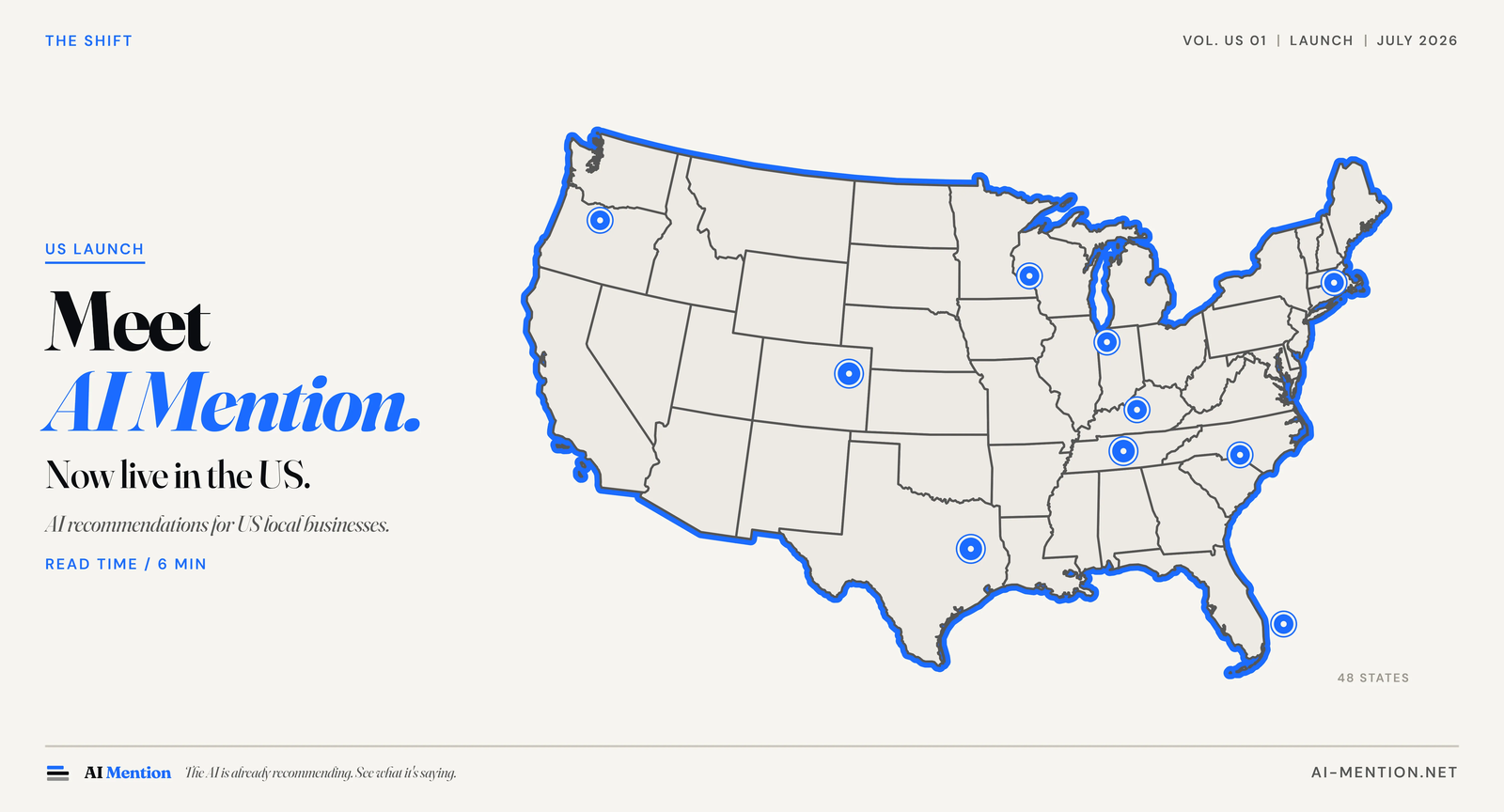
Meet AI Mention. Now Live for US Local Businesses.
Hi. If you own a local business somewhere in the US, you already know Google. You know Yelp. You probably know the Google Business Profile inside out because you have been keeping it warm for years. What you may not know yet is whether ChatGPT, Claude, or Gemini are naming your business when your neighbors ask them for a recommendation. That is what AI Mention watches. And it is now live for US local businesses on ai-mention.net.
This post is the short version of what we do, why we exist, and why it matters more this year than at any point since the launch of the smartphone.
The number that changed everything
BrightLocal's 2026 Local Consumer Review Survey (1,002 US adult consumers) put a hard number on what a lot of small business owners have been feeling. Forty-five percent of US consumers now use AI tools like ChatGPT, Gemini, or Perplexity to find local businesses. Last year that number was 6%. A sevenfold jump in twelve months, and enough to make AI the third most popular source of local business recommendations, behind only Google and Facebook.
The same survey found that 40% of US consumers trust AI platforms to provide business recommendations, and 42% trust them as much as they trust traditional online reviews. Not universal trust yet, but a real signal that when AI names a business, US customers listen.
That is a mile marker. When almost half of US consumers are asking AI to name a plumber in Austin, a dentist in Denver, or a bakery in Nashville, and 40% of consumers trust AI business recommendations, the AI is quietly becoming a new front page for local search. Whether your business is on that front page or not is now a question that matters.
The scale of the shift
Pew Research Center's Americans and AI 2026 report, based on a survey of 5,119 US adults conducted this February, found that 44% of US adults now personally use ChatGPT, up from 18% in 2023, 23% in 2024, and 34% in 2025. Another 24% use Gemini. About half of US adults (49%) now use AI chatbots overall.
Edison Research's Infinite Dial 2026 puts a longer-arc lens on it. Ninety-three percent of Americans age 12 and older are familiar with at least one generative AI brand, and 57% have ever used a generative AI assistant. Podcasting, for comparison, took 16 years to reach the 57% usage milestone AI has just reached.
This is not a slow curve. This is a market shift.
Small businesses are moving too. The US Chamber of Commerce Foundation reports that half of US small business workers now use AI at work. Among those users, 58% do so regularly. Adoption climbs with company size, from 43% at small businesses with fewer than ten employees to 59% at those with 100-249. Small businesses aren't sitting this out.
What AI Mention watches
Here is the specific thing AI Mention was built to do.
When someone asks ChatGPT for a "family dentist in Denver," or asks Gemini for a "pet-friendly restaurant in Nashville," or asks Perplexity for a "plumber in Portland," an answer comes back. Sometimes the answer names two or three specific businesses. Sometimes it names ten. Sometimes it names none, and the customer gets a hedge back like "there are several good options, you should check reviews."
You have no way to see any of this from your side. Google Search Console tells you what Google shows about your business. It does not tell you what ChatGPT says. There is no leaderboard for AI recommendations. There is no way to type a query into an AI assistant and know what your customer, typing something similar, will actually get back.
That is the gap AI Mention was built to fill. We ask the AI assistants your customers are actually using, in the queries your customers actually type, in your service area, over and over. We watch how often they name your business. We watch how often they name your competitors. We watch what evidence the AI is leaning on when it makes a choice, and we tell you where the gap is between what Google knows about you and what AI knows about you.
The output is a picture across four things: presence, frequency, share of voice, and corroboration. No leaderboard, no rank number. A pattern you cannot see any other way.
Why we built the US version
The honest truth is that we built AI Mention for the UK first. We had customers in Leeds, Bristol, and Sheffield who kept asking why ChatGPT was naming a competitor they had never heard of. So we built the tool to answer them.
But the US market has been ahead of the UK on AI consumer adoption from day one. Forty-four percent of US adults on ChatGPT is significantly higher than the UK equivalent. Small businesses moving faster. Local search platforms like Yelp playing a role that AI models actively pull from. The US market needed its own version, not a translation.
So we built one. Different sources, different platforms in the mix, US-specific everywhere it matters. Same underlying tool. If you run a business anywhere in the country, from a taproom in Portland to a family practice in Louisville to a bakery in Minneapolis, you can check for free where you stand right now.
See what AI is currently saying about your business.
Run a free AI discoverability check on your business name and city. You will see the specific gaps AI looks at in about 30 seconds. No account needed.
Check my AI discoverability →How to try it
The free AI discoverability check runs in about 30 seconds. It reads what AI systems can see about your business from the public web, scores your readiness across the signals AI cross-references most, and gives you a clear list of the biggest gaps. No account needed.
If you want the deeper picture, the paid audit runs actual recommendation tests. Real queries in your service area, run against the AI assistants your customers are actually using, over time. You see when ChatGPT names you, when Gemini names a competitor, and what changed week over week.
But start with the free check. It is fast, it is honest, and it tells you where the visibility gap is before you spend a dollar.
Try it now at ai-mention.net/free-check. A fuller picture of how the check works is on a separate page if you want the longer read first.
How findable is your business to AI?
Run a free check on your business name and city. Discoverability score, the specific gaps AI looks at, no account needed.
Check my AI discoverabilitySources
BrightLocal: Local Consumer Review Survey 2026
Pew Research Center: Americans and AI 2026
Edison Research: The Infinite Dial 2026
US Chamber of Commerce Foundation: Half of Small Business Workers Use AI