How To Get Your Business Cited By Perplexity
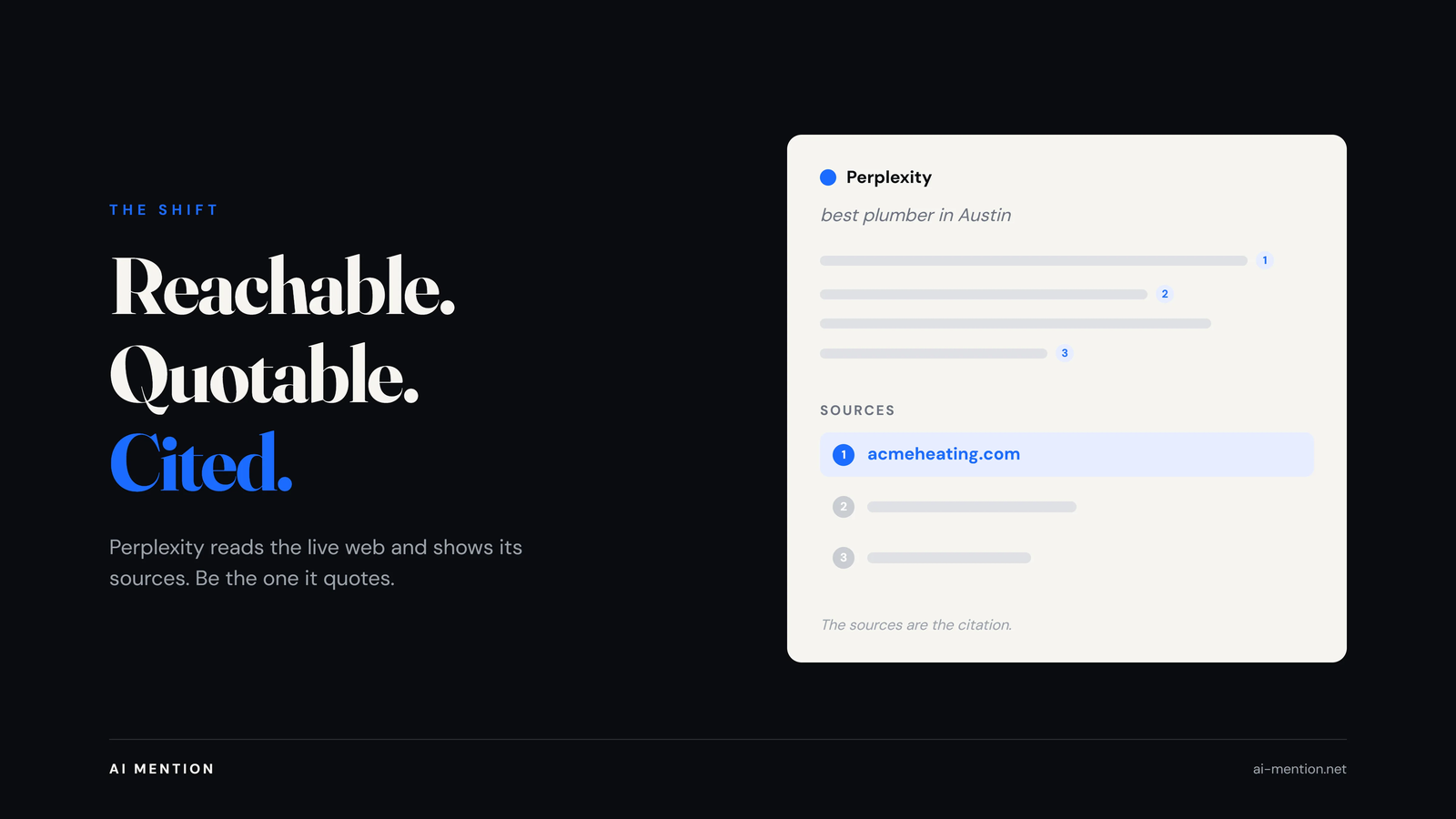
Perplexity is a different kind of animal to ChatGPT or Google's AI, and the difference decides what you have to do to show up in it. It calls itself an answer engine, and it behaves like one: for almost every question it searches the live web, reads the pages it finds, and writes an answer with numbered citations to those pages sitting right there in the text. It shows its work.
That one habit changes the whole job. On Perplexity you are not trying to be remembered. You are trying to be a source it can find and quote, right now. This post is about how a local business becomes that source.
Perplexity is an answer engine, not a chatbot with a memory
A plain chatbot answers largely from what it learned months ago, a frozen snapshot of the web. Perplexity leans the other way. It retrieves live for each question and grounds its answer in the pages it just fetched, then links them. There is far less guessing from stale memory and far more reading of the current web.
The practical upshot is unusual, and it is good news. Your visibility on Perplexity depends on the web it can reach today, not a training cut from last year. If you fix a page, publish a new one, or correct a bad listing, Perplexity can pick that up quickly, because it goes and looks. Of the major platforms, it is the one where getting your house in order shows up fastest.
On Perplexity, "cited" is the currency
There is a difference between being mentioned (your name appears in the answer) and being cited (your page is used as a source and linked). We pulled that apart in our companion piece on ChatGPT. Perplexity is where the distinction stops being academic, because it puts the sources on screen. A citation is a visible, clickable line back to you. It can send a real click, and it is the durable prize: the page Perplexity trusts enough to quote today is the page it reaches for again tomorrow.
What makes a business citable
Across our own testing, some signals show up in the reasoning almost every time, and some are far more hit and miss.
- Local relevance is nearly always present. If the engine cannot tie you to a specific place, it cannot cite you for a place-specific question.
- Authority and credibility are just as reliable.
- Service specificity, how precisely you match the exact thing asked, is consistently one of the strongest signals.
- Reviews and reputation matter, but feature less consistently than owners assume.
- Directory presence is the most variable of all. For some trades it is central; for others it barely registers.
For an engine that fetches and quotes, one thing sits underneath all of these: it has to be able to reach you in the first place. A page it cannot crawl is a page it cannot cite. So before authority or specificity even come into play, your site has to be openly readable by the crawlers, Perplexity's included.
How to become a source Perplexity cites
The work rewards clarity and reachability more than cleverness.
- Be reachable. Make sure your pages can be crawled and are not blocking AI crawlers. If Perplexity's fetcher cannot read the page, nothing else on this list matters.
- Write the quotable fact. "We install tankless and standard water heaters across Austin, licensed and insured, same-day service" is a sentence an answer engine can lift and cite. "Your trusted local experts" is not.
- Publish specifics worth citing. Service area, credentials, pricing, the exact services, short answers to the questions people actually ask. These are what get quoted.
- Earn authority elsewhere. A mention or link on an established local publication or an industry association carries weight, because authority is one of the near-constant signals above.
- Keep it current. Live retrieval rewards fresh, accurate pages and punishes stale ones. A site that has not changed in three years reads as a business that might be gone.
How to test what Perplexity says about you
Open Perplexity and ask the questions your customers would ask, in their words:
- "Who are the best [your trade] in [your city]?"
- "I need a [specific service] near [your area]. Who should I call?"
Then read two things: whether you are named in the answer, and whether your website appears in the numbered sources. Being in the sources is the citation. Click through the sources it did use, so you can see the kind of page it prefers, and do the same for the two or three competitors you lose work to.
Do not assume it matches ChatGPT or Google
In our testing, different AI systems named strikingly different businesses for the exact same question. Because Perplexity is grounded in a live search rather than a model's memory or Google's index, it can diverge the most of all. Being named on ChatGPT or in a Google AI Overview tells you very little about whether Perplexity cites you. If your customers use Perplexity, test Perplexity.
What not to waste time on
Schema markup as the key. Google is blunt in its own guidance on AI search: "Structured data isn't required for generative AI search, and there's no special schema.org markup you need to add." Keep a basic Local Business block for normal rich results, then stop expecting it to be your way in.
Directory blasts. Because directory presence is the most volatile signal, paying to be added to hundreds of generic directories no one reads is effort spent on the least dependable lever. A handful that genuinely match your industry beats a bulk listing service.
Chasing a rank. There is no position to climb inside an answer. There is only whether your page is reachable, specific, current, and trusted enough to be the one it quotes. Get that right and the citation follows.
Frequently asked questions
How do I get my business cited by Perplexity?
Make sure your pages are crawlable and not blocking AI crawlers, publish specific and factual content that answers the questions people ask, keep it current, and earn authority through mentions on trusted sites. Perplexity cites pages it can reach and trust, so reachability and clarity do most of the work.
What is the difference between being mentioned and cited on Perplexity?
Mentioned means your name appears in the answer text. Cited means your website is used as a source and shown in the numbered references. Perplexity makes both visible, but the citation is the linked, clickable prize.
Does Perplexity read my website in real time?
Largely, yes. It searches the live web for each question and grounds its answer in the pages it fetches, rather than relying only on frozen training memory. That is why changes you make can be picked up quickly.
How do I check if Perplexity cites my business?
Ask Perplexity the questions your customers would, then look at both the answer and the numbered sources beneath it. If your site is in the sources, you have been cited. Run it a few times and compare against competitors.
How fast does Perplexity pick up changes to my site?
Faster than memory-based tools, because it retrieves live. There is no fixed timeline, but a reachable, updated page can start being cited far sooner than it would enter a model's training data.
Does a Perplexity citation drive traffic?
It can. Because the citation is a visible, linked source, a reader can click straight through to you, which is more than a passing mention with no link offers. Treat citations as both a trust signal and a genuine referral path.
Is Perplexity citing your business?
Run a free check on your business name and city. See whether AI crawlers can reach you and the signals they read. No account needed.
Check my AI visibility